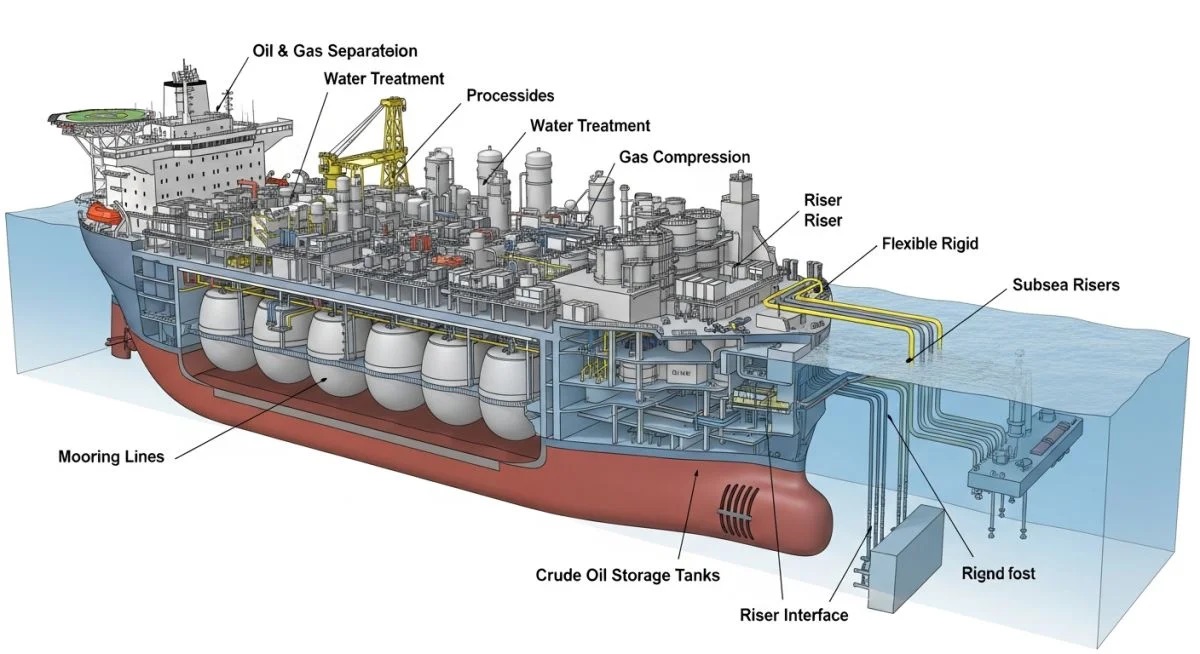
Brief Introduction of FPSO Engineering:
A Complete Overview of Floating Production Storage & Offloading
Floating Production Storage and Offloading (FPSO) vessels are among the most advanced offshore facilities in the oil & gas industry. They combine hydrocarbon production, processing, storage, and export into a single floating asset, making them the preferred solution for deepwater and remote offshore fields.
An FPSO receives multiphase fluids from subsea wells, separates oil, gas, and produced water, stabilizes crude oil for storage, compresses and treats natural gas, processes produced water for disposal or reinjection, stores export-quality crude, and offloads it to shuttle tankers.
Typical Production Flow
Reservoir → Subsea Wells → Christmas Tree → Flowline → Production Riser → Turret → Inlet Manifold → Three-Phase Separator → Oil Processing → Gas Compression → Produced Water Treatment → Cargo Storage Tanks → Offloading Manifold → Shuttle Tanker
Major Process Systems
• Production Inlet & Slug Handling • Three-Phase Separation • Crude Oil Stabilization
• Gas Compression & TEG Dehydration • Produced Water Treatment • Utility & Power Generation Systems
• Flare & Vent Systems • Safety Instrumented Systems
Key Hull & Marine Systems
• Cargo Oil Storage Tanks • Ballast System • Turret Mooring • Pump Room
• Accommodation Block • Helideck • Machinery Spaces
Typical Design Parameters
• Oil Production: 20,000–250,000 BOPD
• Gas Handling: 50–500 MMSCFD
• Storage Capacity: 0.5–2.5 Million Barrels
• Water Cut: 0–95% • Separator Pressure: 5–70 barg • Design Life: 20–30 Years
Common Operational Challenges
• Slugging • Foaming & Emulsion Formation • Sand Production • Wax & Hydrate Formation
• Scale & Corrosion • Compressor Surge • Pump Cavitation
Key Engineering Standards
API 12J • API RP 14C • API RP 14E • API 520/521 • API 610 • API 617 • API 682 • ASME Section VIII • ASME B31.3 • ISO 10418 • ISO 13702 • IEC 61511 • DNV • NORSOK • SOLAS
This infographic summarizes the major systems, process flow, equipment, design parameters, and engineering concepts behind FPSO facilities, providing a practical reference for process, mechanical, piping, and offshore engineers.

Key Front End Engineering Design Deliverables for FPSO Projects
At the FEED (Front-End Engineering Design) stage of an FPSO project, the focus is on translating concept into a well-defined, execution-ready plan. The deliverables created here form the backbone of cost estimation, risk reduction, and smooth project execution.
Listed below are core FEED deliverables;
- Process Design Package: Includes Process Flow Diagrams (PFDs), Heat & Material Balances, and initial P&IDs. These define how hydrocarbons will be processed, treated, and exported.
- Equipment Specifications & Datasheets: Detailed specifications for critical equipment like separators, compressors, pumps, and heat exchangers to guide procurement and vendor engagement.
- Plot Plans & Layouts: Preliminary general arrangement drawings showing topside module layouts, equipment positioning, and space optimization on the FPSO deck.
- Piping & Instrumentation Inputs: Line sizing, piping classes, valve philosophy, and instrument selection to ensure safe and efficient operations.
- Utility & Offsite Systems Design: Covers power generation, water systems, flaring, and other support utilities essential for continuous FPSO functioning.
- Safety & Risk Studies: HAZID, HAZOP, and preliminary QRA studies to identify and mitigate operational and process risks early.
- Weight, CAPEX & Schedule Estimates: Key inputs for project viability, including weight control reports, cost estimation, and execution timelines.
- 3D Model (Early-Stage): A basic 3D model to visualize integration, identify clashes, and improve multidisciplinary coordination.
- Procurement Strategy Inputs: Vendor lists, long-lead item identification, and contracting strategies to streamline downstream execution.